Teaching with Integrity: Lineage & Cultural Respect in US Dojos
After a 2025 BJJ credential scandal, US dojo owners face harder questions about lineage verification, cultural transmission, and avoiding appropriation while teaching martial arts.
Key Takeaways
- Lineage verification matters more than ever: Following a July 2025 controversy involving Rodrigo Gracie Jr. that exposed credential inflation in Brazilian Jiu-Jitsu, instructors must be prepared to explain their direct line of transmission from recognized masters, not just name-drop famous teachers.
- Cultural etiquette is a marker of legitimate transmission: Practices like bowing on and off the mat, using original terminology (sankaku, dan/kyu ranks), and teaching the cultural values embedded in technique signal authentic instruction rooted in the art's country of origin.
- American adaptation is not appropriation when properly authorized: Instructors holding technical or teaching licenses recognized by the Japanese koryu community, Korean governing bodies, or Brazilian federation structures can teach outside the origin culture without appropriation, provided they maintain transparent lineage connections.
- Direct transmission preserves authenticity: A 2024 North Carolina case shows the model: Instructor Hewett trained with Hachi Walter Todd in the late 1980s; Todd, an 8th Dan, was appointed branch director for Shudokan in the United States by founder Toyama himself, creating a verifiable chain of knowledge transfer.
- Demystification risks cultural disconnection: As martial arts knowledge became widely published in the 1990s and moved beyond first-generation immigrant instructors, American dojos increasingly teach technique divorced from its Okinawan, Japanese, Korean, or Brazilian cultural context, weakening the transmission model that once guaranteed quality.
- Transparency builds trust in 2026: Organizations like the United States Taekwondo Alliance, founded in 2023 by Grandmaster Doug Cook, address credential concerns through standardized curriculum, certification across multiple levels, cultural training tours to Korea, and published documentation of lineage and doctrine.
Why Lineage and Cultural Authenticity Are Under Scrutiny in 2026
The July 2025 controversy involving Rodrigo Gracie Jr. brought credential inflation into sharp focus for the Brazilian Jiu-Jitsu community. The incident exposed tensions within the Gracie family itself, the Hélio versus Carlos lineage divide, and highlighted how easily instructors can name-drop famous connections without possessing legitimate rank or teaching authorization. As credential fraud becomes easier to perpetrate in an era of online certificates and self-promoted "grandmasters," students and dojo owners alike are asking harder questions about what lineage actually means.
Lineage is the direct line of instructors and teachers through whom the knowledge you are studying has flowed. In martial arts, this chain of transmission is supposed to guarantee not just technical accuracy but also cultural context, ethical instruction, and quality control. The problem: because martial arts credentials are hard to verify in the United States, unscrupulous teachers routinely tell half-truths or outright lie about the depth of their training in a given art or style.
At the same time, a broader cultural reckoning is underway. In the 1990s, the publication of key secret texts and the establishment of a large body of historical information contributed to what scholars call the "demystification" of karate, lessening the perceived need for direct attachments to the people and culture of Okinawa. Karate was remade as a set of Western knowledge and practices, often stripped of its original cultural fabric. This shift has implications across all Asian martial arts taught in the United States, from taekwondo to kendo to Brazilian Jiu-Jitsu, which despite its name carries deep roots in Japanese judo.
How Direct Transmission Establishes Authenticity and Quality
For traditional arts like karate, the model of direct transmission remains the gold standard. Because knowledge is passed down from master to student, those established connections to the founder ensure the dojo's quality and authenticity. A 2024 profile from North Carolina illustrates this in practice: Instructor Hewett, who has been teaching karate for 43 years and studying it for 45 years, trained with Hachi Walter Todd in the late 1980s. Todd, an 8th Dan black belt, had been appointed Shibu-cho (branch director) for Shudokan in the United States by Toyama himself. Todd promoted Hewett to 6th Dan and awarded him the title of Kyoshi (advanced teacher). The inheritance is verifiable and traceable, documented in both organizational records and the living memory of the koryu community.
This is the model that historically separated legitimate instruction from fraud: a clear, unbroken chain of named teachers, each holding recognized rank and teaching authorization within a formal system. Legitimate instructors can explain their training background and lineage in detail. They know the names, the dates, the tests, the ceremonies. Fraudulent instructors cannot.
Brazilian Jiu-Jitsu's Complex Heritage: Japanese Roots, Brazilian Innovation, American Evolution
Brazilian Jiu-Jitsu evolved from Japanese Jiu-Jitsu and judo, emphasizing ground fighting and sport competition. The origin story is well documented: Mitsuyo Maeda, a Japanese judoka and prizefighter, settled in Brazil in 1914, where he eventually taught his techniques to a young Carlos Gracie. Carlos, impressed and inspired, began developing his own interpretation of Maeda's teachings, which his brother Hélio would further refine into what we now recognize as BJJ.
This heritage is visible in everyday BJJ practice. Bowing on and off the mat, respect for instructors, and the use of Japanese terminology for techniques (like sankaku for triangle choke) all nod to the art's Japanese roots. Yet BJJ also embraces evolution and individual expression, shaped as much by Brazilian surf culture and the rise of mixed martial arts as by traditional Japanese discipline. The result is a martial art that honors its lineage while remaining open to innovation, a balance that has fueled its explosive growth in the United States over the past three decades.
The July 2025 Rodrigo Gracie Jr. controversy underscored the stakes of this heritage. When lineage becomes a marketing tool rather than a record of legitimate transmission, it erodes trust across the entire community and makes it harder for students to distinguish qualified instructors from pretenders.
Korean Taekwondo's American Story: Standardization, Adaptation, and Hybrid Styles
Taekwondo's arrival in the United States reveals another pattern of cultural transmission and adaptation. In 1962, Si-Hak (Henry) Cho opened the first commercial Korean martial arts school in the U.S. in New York City. That same year, Jhoon Rhee relocated to Washington, D.C., and later opened his own taekwondo school. In 1969, Haeng Ung Lee relocated to Omaha, Nebraska, where he opened his own school, founding the American Taekwondo Association (ATA) style.
The ATA's founding story illustrates both the promise and the complexity of cultural transmission. In 1968, Korean General Hong Hi Choi, the man responsible for originally standardizing taekwondo in 1955, met with then-Master Haeng Ung Lee, who at the time was teaching a taekwondo-Japanese mixed martial art to his organization of followers. General Choi taught Eternal Grand Master Lee the first 16 Cheon-jee forms of taekwondo in only four days and three nights, a compressed transmission that allowed rapid growth but also raised questions about depth of understanding.
Some American schools melded aspects of Japanese karate with traditional taekwondo, perhaps a reflection of the early era when most Americans recognized "karate" but not taekwondo, and so schools often used that terminology for marketing purposes. This pragmatic adaptation helped taekwondo gain a foothold in the United States but also created lineage confusion that persists in 2026. Instructors who trained in Korea often (but not always) have cultural insight about taekwondo that American instructors may lack, making geographic origin of training another factor students must weigh when evaluating a school.
Cultural Etiquette as a Marker of Legitimate Transmission
In many martial arts traditions, bowing and other forms of etiquette are central to training. These customs are often deeply ingrained in the cultures from which the martial art originates. By adopting these practices, students not only show respect to their instructors and fellow practitioners but also gain a deeper appreciation for the cultural values associated with martial arts.
Cultural etiquette functions as both a pedagogical tool and a quality signal. When an instructor teaches students to bow properly, to address senior students and instructors with appropriate titles (sensei, sabom, professor), and to use original terminology for techniques and concepts, that instructor is transmitting more than just physical movement. They are passing on a worldview, a set of values about respect, humility, and continuous self-improvement that are inseparable from the martial art itself.
Conversely, when these practices are absent or performed carelessly, it often signals a break in the transmission chain. The instructor may have learned techniques from videos or books rather than from a living teacher embedded in the culture. This is not an absolute rule; cultural practices can be learned and adopted with sincerity and respect. But it is a useful heuristic for students evaluating potential schools.
Avoiding Appropriation While Enabling Cross-Cultural Practice
The question of cultural appropriation arises naturally when discussing martial arts taught outside their countries of origin. The answer, according to scholars and practitioners of Japanese koryu (classical martial arts), is straightforward: if one's teacher is recognized by the Japanese koryu community at large, and one has received a technical license, a teaching license, or authorization to instruct, there is no issue of appropriation involved.
More pragmatically, when traditional Japanese martial arts are taught outside the original culture, changes are inevitable. Entire traditions might be lost while we wait for people from the "correct" demographics to take interest. Martial arts are increasingly seen as offering ways to cross cultural boundaries for mutual benefit, provided that crossing is done with respect, transparency, and accountability.
This means American instructors have a responsibility to be honest about their training, to credit their teachers and the cultural origins of their art, and to continue learning about the cultural context in which their techniques were developed. It also means students have a right to ask questions: Where did you train? Who promoted you to your current rank? Are you recognized by any governing body in the art's country of origin? These questions are not disrespectful; they are essential quality control in an unregulated industry.
Transparency and Organizational Accountability in 2026
Some American organizations are actively addressing the transparency and lineage crisis. The United States Taekwondo Alliance, founded in 2023 by Grandmaster Doug Cook, 8th Dan, promotes excellence in the traditional and evolving art of taekwondo. While continuing to promote the legacy of Chun Kwanjangnim, the organization actively inserts its own contributions into the great chain of martial wisdom, focusing on the art rather than the sport and consciously viewing taekwondo as a Way of Life.
With affiliate schools across America, the USTA faithfully maintains traditional technique and Korean martial arts doctrine by hosting educational seminars, online and in-dojang classes, a comprehensive standardized curriculum, certification across a number of levels, cultural and training tours to Korea, and through HOONLYUN: The Journal of the USTA. This multi-layered approach addresses the demystification problem: it provides transparent documentation, ongoing education tied to cultural context, and regular opportunities for American instructors to travel to Korea and train with Korean masters, maintaining the living transmission that print and video alone cannot sustain.
Instructors play a key role in negotiating the balance between cultural adaptation and the preservation of the martial art's identity. While instructional styles vary by culture, traditional principles such as those in kendo are maintained across borders through organizations that enforce standards, document lineage, and create accountability structures that transcend national boundaries.
The Demystification Problem: What Is Lost When Cultural Connection Fades
As martial arts moved away from the first generation of Japanese and Okinawan immigrants sharing their cultural treasure of body-mind unity with American students, the next generation consisted of Americans opening their own schools. No more direct transmission from the source culture. While great respect is often shown to the memory of founders like Miyagi Chojun or Kano Jigoro, some dynamic has been lost.
The 1990s publication of previously secret training manuals and techniques accelerated this shift. Information that once required years of dedicated study under a master became available in books, videos, and eventually YouTube tutorials. The result was a democratization of knowledge but also a flattening of understanding. Techniques could be copied, but the cultural context, the ethical framework, and the transmission of intangible qualities from teacher to student were harder to reproduce.
This creates a dilemma for 2026 dojo owners. On one hand, broader access to martial arts training is a net positive; gatekeeping based solely on ethnicity or geographic origin would be both impractical and unjust. On the other hand, something essential is at risk when martial arts become just another fitness modality, stripped of history, lineage, and cultural meaning.
What This Means for Dojo Owners
Editorial analysis, not reported fact:
The current moment demands that US dojo owners take lineage and cultural accountability seriously, not as a marketing angle but as a core part of their professional identity. This means being prepared to answer questions about your training history in detail: Who promoted you to your current rank? Where did you train, and for how long? Are you recognized by any governing body in your art's country of origin? If you cannot answer these questions clearly, you have work to do.
It also means investing in cultural education, both for yourself and your students. This might involve subscribing to journals like HOONLYUN, attending seminars led by visiting masters from Japan, Korea, or Brazil, or organizing cultural training tours that allow your students to experience the art in its original context. These investments signal to prospective students that you are serious about transmission, not just transaction.
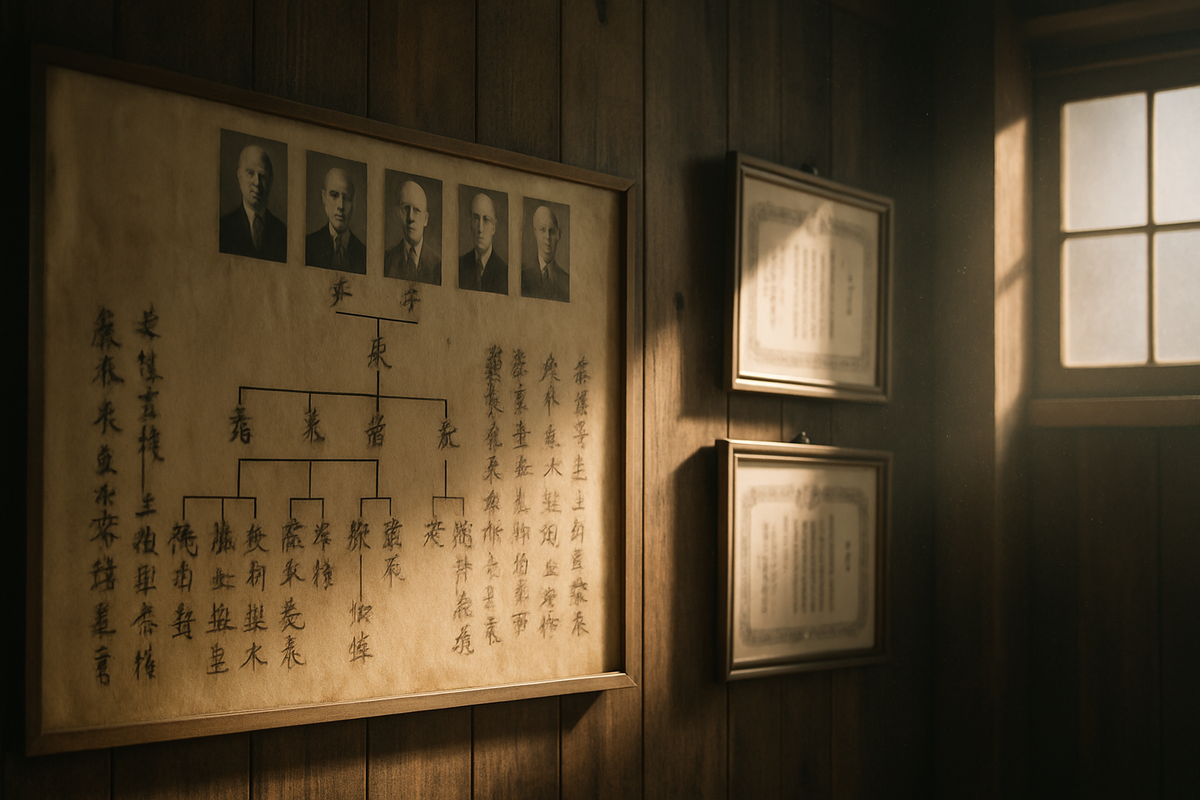
Finally, consider the role of transparency in building trust. Display your lineage chart prominently in your dojo. Include your teachers' names and your rank progression on your website. Make it easy for students to verify your credentials through recognized governing bodies. In an era when credential fraud is common and damaging, transparency is a competitive advantage.
The goal is not to recreate a dojo in Seoul, Okinawa, or Rio de Janeiro on American soil. The goal is to maintain the chain of transmission that gives your teaching legitimacy, depth, and cultural integrity, while adapting intelligently to the needs and context of your American students. That balance is the essence of teaching with integrity in 2026.
Sources & Further Reading
- North Carolina karate instructor's direct lineage to Shudokan founder Toyama (News & Observer, 2024) — verifiable example of traditional transmission model
- The origins of Brazilian Jiu-Jitsu and Mitsuyo Maeda's role in teaching Carlos Gracie (Grapple Arts) — detailed history of BJJ's Japanese roots
- American Taekwondo Association founding history and General Choi's 1968 teaching of forms to Haeng Ung Lee (ATA) — official organizational history
- United States Taekwondo Alliance and cultural training initiatives (USTA, founded 2023) — contemporary model for maintaining cultural connection through standardized curriculum and Korea training tours
Editorial coverage of publicly reported industry developments. Dojo Practice has no commercial relationship with any companies named.