Territory Protection: When Franchises Open Too Close
The Premier Martial Arts litigation shows how consolidation creates encroachment risk. What franchisees should audit in territory clauses before conflicts escalate.
Key Takeaways
- Territory encroachment litigation: In November 2022, 54 Premier Martial Arts franchisees sued Unleashed Brands alleging RICO violations just months after the January 2022 acquisition, highlighting how consolidation increases encroachment risk.
- Protected territory mechanics: Premier Martial Arts offers territory protection within designated Protected Market Areas, but specific conditions and restrictions apply, and radius protections vary by franchise type and local population density.
- Non-compete enforcement: In a five-year Personal Best Karate arbitration case, the arbitrator ordered the franchisee to cease operations and awarded $13,724.90 in damages, with courts rejecting claims that non-compete clauses were unconscionable.
- Technology as compliance tool: Modern franchise territory mapping platforms now automatically detect boundary conflicts before agreements are signed, preventing inadvertent encroachment from poor territory design or inaccurate mapping.
- BJJ market saturation dynamics: Unlike traditional franchises, most Brazilian Jiu-Jitsu gyms operate as independent affiliations rather than franchises, creating different saturation pressures where location quality drives 30-50% performance differences.
When Consolidation Creates Encroachment Risk
The January 2022 acquisition of Premier Martial Arts by Unleashed Brands illustrates how quickly territory conflicts can escalate. At purchase, Premier claimed 560 licenses sold with approximately 200 locations open. By November 2022, 54 franchisees filed federal suit alleging RICO violations and raising complaints about unrest across all six of Unleashed Brands' portfolio brands.
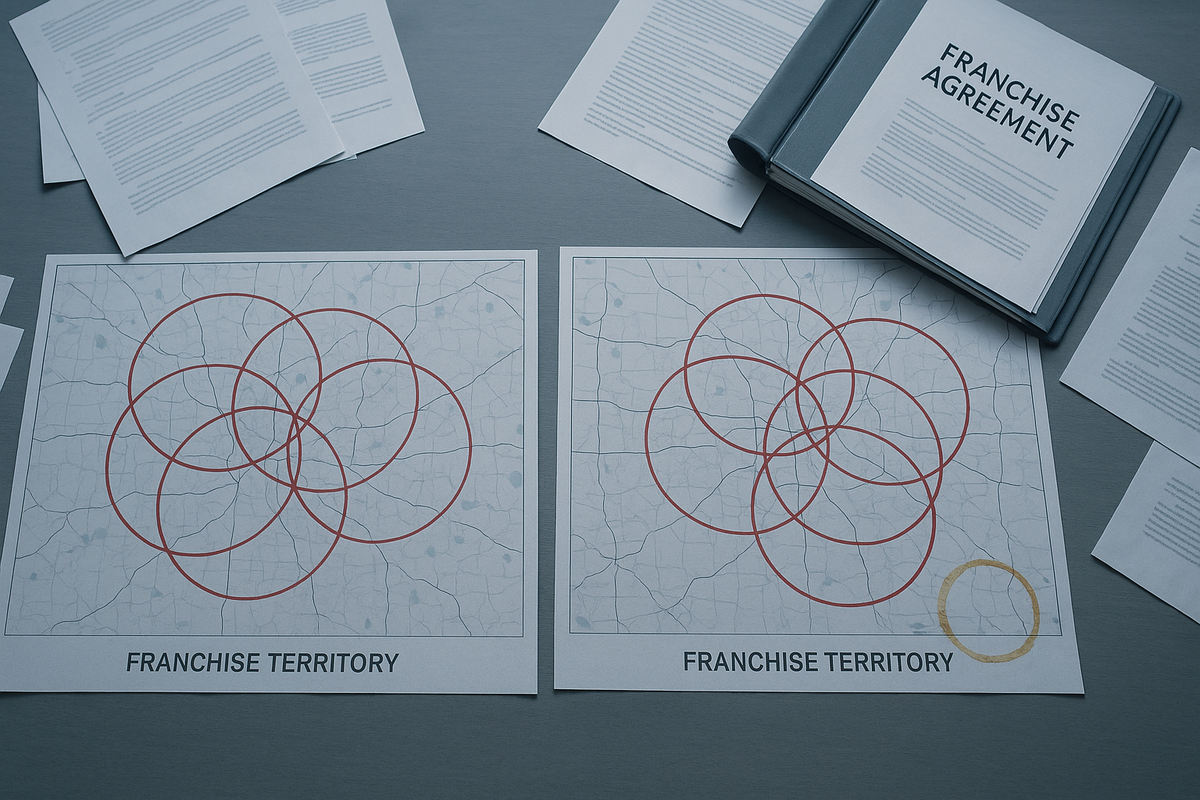
Territory encroachment occurs when a franchisor or another franchisee enters or competes within an existing franchisee's protected territory. The practice can happen intentionally or inadvertently, but it always negatively affects the franchisee's market potential. Most franchise owners prioritize protecting their territorial investment over litigation, making early legal consultation critical.
This litigation pattern reflects broader saturation and consolidation pressure across martial arts franchising, where growth strategies increasingly conflict with existing franchisees' territorial protections.
How Territory Protection Actually Works
Territory protection language in franchise agreements should stipulate that additional units or new franchisees within the system cannot open locations within a certain radius of a franchisee's development area. The distance varies depending on franchise type, local population, and several other market factors.
Premier Martial Arts offers territory protection to its franchisees, ensuring exclusive rights within their designated Protected Market Area subject to specific conditions and restrictions. This protection aims to safeguard franchisees from internal competition, allowing them to focus on growing their business without concerns of another Premier Martial Arts studio opening nearby.
Licensing-based systems operate differently. In ATA Taekwondo and similar organizations, the license is merely a license for utilizing materials provided by the organization but secures a territory, preventing the establishment of two identical schools in the same area. This distinction matters because licensing agreements typically offer narrower protections than full franchise agreements.
When Technology Fails to Prevent Conflicts
Encroachment is not always the result of aggressive expansion; it often arises from poor territory design or inaccurate mapping systems. Modern franchise territory mapping technology has become a critical compliance tool, with platforms like Zors automatically detecting boundary conflicts before an agreement is signed and featuring geospatial mapping with clear, data-driven territory boundaries and automatic conflict alerts during franchise sales workflows.
Despite these tools, "brick-and-mortar" encroachment frequently occurs where a franchisor opens another location—whether company-owned or franchisee—in a franchisee's geographic territory or in close proximity. The definition of "close proximity" becomes the battleground in most disputes.
Non-Compete Enforcement After Termination
The Personal Best Karate case demonstrates how courts treat post-termination competition. After a five-year legal fight with its former franchisee Personal Best Karate of Norwood, Inc., the arbitrator ordered the Moscas to cease all operations per the agreement's non-compete clause and awarded PBK, Inc. $13,724.90 in damages.
The judge confirmed the arbitration award while disregarding the Moscas' claim that the franchise agreement's non-compete clause was unconscionable, suggesting courts generally enforce these provisions in martial arts franchising. This enforcement pattern extends beyond martial arts; similar franchise termination clauses can nullify instructor credentials and business operations post-termination.
Some franchise agreements contain non-compete clauses that specify franchisees cannot compete within 10 miles of the same franchise and also anywhere within the US. Courts look at the facts of every case when determining a non-compete clause and consider such things as the reasonableness of the restriction(s) and whether the signer was actually privy to anything that will interfere with the business of the drafter.
The BJJ Exception: Independent Growth Without Franchise Protections
Brazilian Jiu-Jitsu presents a contrasting model. BJJ is booming, with BJJ gyms opening up in cities all over the world, from small neighborhood dojos to full-blown training centers with hundreds of students. Unlike traditional martial arts franchises, most BJJ academies operate as independent affiliations rather than franchises, creating different market dynamics.
BJJ academy owners need to make sure their academy is in an area where there will likely be plenty of potential students, but isn't so close to another jiu-jitsu academy that they're competing for the same population of students. Gyms in poor locations underperform by 30-50% vs well-located competitors, and the same applies to martial arts schools.
This independent model avoids franchise territory disputes but creates its own saturation challenges. Without formal protections, BJJ academy owners must rely entirely on location analysis and market differentiation rather than contractual territory rights.
Comparing Franchise Investment Models and Territory Value
Territory protection directly impacts franchise valuation. Franchise investment ranges for Premier Martial Arts run $141K-$252K, making territorial exclusivity a substantial component of the investment thesis. When that protection erodes through encroachment, franchisees lose both market share and asset value.
The broader pattern of multi-unit franchise consolidation across boutique fitness shows how private equity-backed growth strategies can conflict with franchisee protections. When franchisors prioritize unit count growth over territorial integrity, disputes become inevitable.
What This Means for Studio Operators
Editorial analysis, not reported fact:
Martial arts studio owners considering franchise opportunities should audit territory language before signing. Request specific radius protections in miles or zip codes, not vague "market area" definitions. Ask whether the franchisor retains rights to open company-owned locations within your territory and under what conditions they can place additional franchisees nearby.
Existing franchisees facing potential encroachment should document the threat immediately and consult franchise counsel before the competing location opens. Once a location is operational, remedies become more limited and expensive. Early dialogue with the franchisor often resolves boundary disputes more efficiently than post-opening litigation.
Independent operators and BJJ academy owners without franchise protections should treat location selection as their primary competitive moat. The 30-50% performance difference between well-located and poorly-located schools means demographic analysis and traffic pattern research deserve significant upfront investment.
Sources & Further Reading
- Franchise Times coverage of Premier Martial Arts lawsuit, documenting the November 2022 RICO allegations
- Franchise Lawyer overview of territory encroachment, including modern mapping technology and conflict detection
- Personal Best Karate arbitration case analysis, showing enforcement of non-compete clauses
- Lusthaus Franchise Law guide to multi-unit territory rights, covering protection mechanics
- BJJ gym opening guide, discussing independent academy market saturation dynamics
Editorial coverage of publicly reported industry developments. Dojo Practice has no commercial relationship with any companies named.