Weapons Training: Revenue Opportunity or Liability Risk?
Traditional martial arts schools can unlock premium revenue with kobudo programs, but most lack explicit insurance coverage for weapons training. Here's how to close the gap.
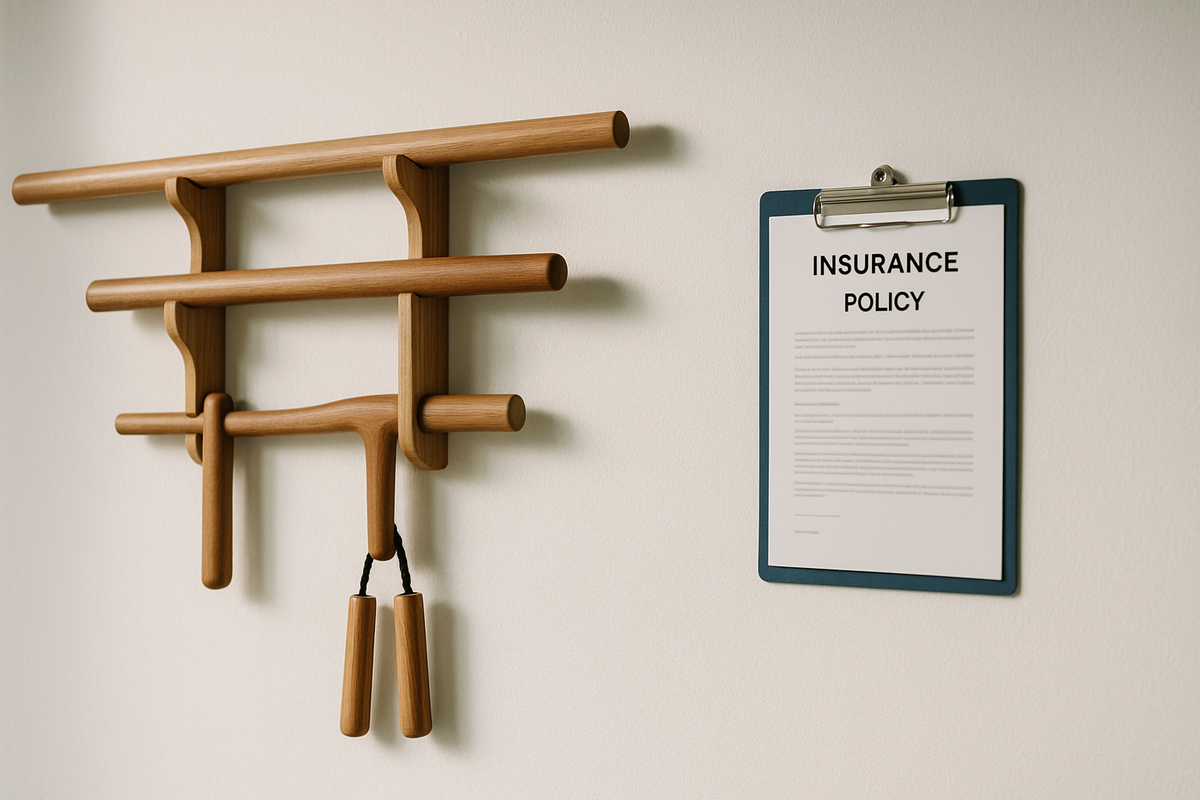
Key Takeaways
- Weapons training riders are not standard: Traditional karate and kung fu schools teaching kobudo (bo staff, nunchaku, sai, tonfa) need explicit insurance coverage for weapons training, which typically costs $300–1,000 annually as an add-on to base martial arts liability policies.
- Revenue potential is significant but underutilized: Weapons programs can command $30–60 monthly add-ons or $100–150 per workshop, potentially pushing average monthly revenue per student from $140–185 to over $210, mirroring top-performing schools.
- Legal precedent raises the stakes: The November 2018 Del Mar Jiu Jitsu Club case resulted in a $46.5 million verdict for catastrophic injury during sparring, creating a roadmap for plaintiffs' attorneys and heightening liability exposure for all high-risk training, especially weapons programs.
- Waivers do not eliminate liability: Parental waivers for minors can be challenged in court, and gross negligence claims pierce standard liability releases; one serious injury lawsuit costs $50,000+ in legal fees even if the dojo wins.
- Safety protocols directly reduce costs: Documented protocols for blunted or padded weapons, supervised forms-only practice, and instructor certification can lower insurance premiums and strengthen legal defenses in the event of a claim.
The Revenue Gap in Traditional Martial Arts
The US martial arts market has grown to 76,364 studios as of 2026, up 15.3% annually since 2021, but participation has flatlined at approximately 18 million Americans. This saturation is hitting traditional schools hardest. MMA studios average $254,083 in annual revenue while kung fu schools average just $74,783, and karate schools cluster at the lower end of the revenue distribution.
Weapons training represents an underexploited differentiation lever. Schools already offer private lessons at $75–150 per hour and specialized workshops, but weapons programs remain either absent or underpriced. A structured kobudo track charging $30–60 monthly or semester-long introductory workshops at $100–150 could materially narrow the revenue gap between traditional schools and higher-earning disciplines.
Advanced or specialty-track students drawn to weapons training typically exhibit higher retention and upsell responsiveness. Top-performing schools push average monthly revenue per student to $210 or more by stacking uniform sales, testing fees, and specialty programs. Weapons training fits naturally into this premium tier.
Why the Del Mar Verdict Changes the Calculation
On November 29, 2018, beginning Brazilian Jiu-Jitsu student Jack Greener suffered catastrophic neck injuries during a sparring session at Del Mar Jiu Jitsu Club in San Diego, leaving him temporarily paralyzed from the neck down. In March 2023, a jury awarded Greener $46,475,112.33.
As Greenberg Roth Sobel & Moss LLP noted, the plaintiff's success "creates a significant question as to the scope of potential liability that might arise from martial arts-related injuries, as there is now a highly publicized roadmap in place for the plaintiffs' attorneys to repeat." While the case involved grappling, weapons training presents an arguably worse exposure profile. Courts and juries view weapons as added risk requiring demonstrable safety protocols and instructor competency, not as inherent to martial arts practice the way sparring is perceived in grappling disciplines.
A nunchaku strike causing eye injury or a bo staff collision resulting in concussion creates obvious, foreseeable harm vectors. Without documented safety measures and explicit insurance coverage, a weapons-related injury claim could exceed a dojo's entire asset base.
The Insurance Audit: Verifying Weapons Coverage
Most martial arts schools pay $1,100–1,600 annually for baseline general liability insurance, with industry-standard limits of $1 million per occurrence and $2 million aggregate. However, traditional karate schools teaching kobudo need explicit coverage for weapons training—not all standard martial arts policies automatically include this.
Owners should immediately request their policy declarations page and endorsement schedule, searching for language like "weapons training" or "kobudo." If absent, the school is self-insured for weapons-related claims. Well-built policies add weapons-training riders for $300–1,000 per year, alongside tournament coverage and other specialized endorsements.
What to Ask Your Insurance Agent
Request explicit confirmation in writing that your policy covers injuries arising from bo staff, nunchaku, sai, tonfa, and any other weapons in your curriculum. Ask your agent to review coverage exclusions such as competitions or weapons training to identify gaps. If weapons training is excluded or limited, obtain a quote for a rider before launching or expanding your program.
Specialized martial arts insurers like those profiled by GymDesk often write sparring, submissions, takedowns, weapons training, and kids' classes into coverage from the start, not as buried endorsements. Switching carriers may be more cost-effective than patching a policy riddled with exclusions.
Revenue Math: Pricing and Uptake Models
Average monthly revenue per active student ranges from $140–185, and schools diversify income through memberships, belt testing, gear sales, private lessons, and camps. Weapons training can fit into multiple revenue streams simultaneously.
A conservative model assumes 20–30% of advanced students (typically brown belt and above) enroll in a monthly weapons track priced at $40 add-on. For a 100-student school with 25 advanced practitioners, 6–8 weapons students generate $240–320 in monthly recurring revenue, or $2,880–3,840 annually. A single semester-long workshop series priced at $125 and filled with 12 students yields $1,500 in non-recurring revenue.
Combined with private weapons lessons at $100–150 per hour for competition forms coaching, a weapons program could add $5,000–8,000 in gross annual revenue for a small to mid-sized traditional school. For schools at the $75,000 kung fu average, this represents a 7–11% revenue lift—meaningful margin expansion in a saturated market.
Risk Mitigation Playbook
Insurance riders reduce financial exposure, but operational protocols reduce the likelihood of claims in the first place. Ensure your insurer understands that training weapons are typically blunted or padded, and provide evidence of safety protocols governing weapons storage, handling, and use.
Documented Safety Protocols
- Require foam-tipped bo staffs, padded nunchaku, and wooden or rubber training weapons only—no live blades or metal.
- Mandate forms-only practice until students demonstrate solo proficiency; no partner drills until instructor-certified.
- Establish minimum belt rank prerequisites (typically brown belt or 1st kyu) for weapons program entry.
- Maintain written instructor qualification records showing weapons-specific training or certification.
- Store weapons in locked cabinets accessible only to instructors, distributed at the start of class and collected before dismissal.
These protocols serve dual purposes: they reduce premium costs when submitted to underwriters during policy renewal, and they create a documented standard of care that defends against negligence claims.
Waiver Limitations for Minors
Signed waivers reduce liability but don't eliminate it, and waivers can be challenged in court, especially for gross negligence claims. More critically, most martial arts students are minors, and in certain jurisdictions, parental waivers do not completely bar a minor's right to sue.
A weapons injury to a minor during a kids' kobudo class may pierce even a signed waiver if the dojo is found negligent in supervision or instruction. This is why explicit insurance coverage and documented safety protocols are non-negotiable for youth weapons programs.
The Decision Tree: Is Weapons Training Right for Your School?
Weapons programs make economic sense for schools that meet three criteria: a critical mass of advanced students (15+ brown belts or equivalent), an instructor with documented weapons training or certification, and the financial capacity to add a $300–1,000 annual insurance rider plus initial equipment investment of $500–1,500.
Schools operating on thin margins or lacking advanced student depth should prioritize core membership growth before layering specialty programs. Conversely, established traditional schools with plateau enrollment and strong retention at advanced ranks have the most to gain. Weapons training offers both premium pricing leverage and brand differentiation in a crowded market.
The calculus is straightforward: a $500 annual insurance rider and $1,000 in padded weapons equipment generate a $5,000–8,000 revenue lift with manageable risk, provided safety protocols are documented and enforced. The cost of failing to secure coverage while offering weapons training is catastrophic.
What This Means for Studio Operators
Editorial analysis, not reported fact:
The tension between revenue opportunity and liability exposure in weapons training reflects a broader challenge facing traditional martial arts schools in 2026: how to differentiate and command premium pricing in a saturated market without assuming unmanaged risk. The Del Mar verdict has fundamentally reset the liability landscape, and weapons training sits at the intersection of higher perceived risk and higher revenue potential.
Studio operators should approach weapons programs as a strategic investment requiring three inputs: explicit insurance coverage, documented safety infrastructure, and qualified instruction. Schools that treat weapons training as an informal add-on without verifying coverage are gambling with business-ending exposure. Conversely, schools that systematically address these three inputs can unlock meaningful margin expansion while managing risk to acceptable levels.
The immediate action item is an insurance audit. Pull your policy declarations page this week and confirm weapons training coverage in writing. If excluded, obtain a rider quote before your next weapons class. If your agent cannot provide clarity, consider switching to a specialized martial arts insurer. The modest annual cost of a rider is a rounding error compared to the cost of a single uninsured claim or the revenue left on the table by avoiding weapons programs entirely.
Sources & Further Reading
- Vibe Fam: Martial Arts Insurance 2026, comprehensive overview of coverage types, exclusions, and cost benchmarks
- Greenberg Roth Sobel & Moss: Developments in Martial Arts Practice Liability, legal analysis of the Greener v. Del Mar Jiu Jitsu Club case and its implications
- Panish Shea & Boyle LLP: $46.5 Million Verdict for Martial Arts Student, case summary and jury award details
- Martial Arts School Insurance: How Waivers Really Work, waiver limitations and minor liability issues
- Black Belt CRM: Martial Arts School Business Benchmark Report, revenue benchmarks by discipline
- Member Solutions: Martial Arts Business Revenue Optimization Strategies, pricing models and revenue streams
Editorial coverage of publicly reported industry developments. Dojo Practice has no commercial relationship with any companies named.