ADA Compliance for Martial Arts Schools: What Owners Must Know
Martial arts schools face ADA Title III compliance requirements for physical facilities and digital access. Penalties reach $150,000, but adaptive programs unlock new revenue.
Key Takeaways
- Title III ADA coverage: Martial arts schools are classified as places of public accommodation under the ADA, requiring compliance with accessibility standards that became mandatory on March 15, 2012.
- The "readily achievable" standard: Barrier removal must be easy to accomplish without much difficulty or expense, scaled to your school's size and resources, covering entrances, training mats, equipment access, and locker rooms.
- Non-compliance penalties: First violations can draw civil penalties up to $75,000, with subsequent violations reaching $150,000, plus litigation costs and reputational damage.
- Physical modifications cost range: Accessible parking runs $3,000 to $5,000, restroom renovations $5,000 to $15,000 per facility, and ramp installations $1,500 to $2,500, with mat ramping solutions often under $1,000.
- Adaptive martial arts market opportunity: Nearly 240 million children worldwide live with disabilities that could benefit from adapted programs, representing an untapped revenue stream and competitive differentiator for compliant schools.
- Website accessibility matters: ADA Title III digital lawsuits jumped 27% in 2025, with courts consistently applying WCAG 2.1 Level AA standards to martial arts school websites and registration systems.
Why ADA Compliance Applies to Your Martial Arts School
Title III of the Americans with Disabilities Act explicitly defines fitness centers, gyms, and recreational sports facilities as places of public accommodation. This means your dojo is legally required to remove architectural barriers and ensure program access when it is "readily achievable" to do so. The current standard, the 2010 ADA Accessibility Guidelines, became mandatory on March 15, 2012, and applies to both newly constructed facilities and alterations to existing spaces.
The "readily achievable" threshold is not one-size-fits-all. According to compliance guidance for fitness facilities, this standard scales with your business size and resources. A multi-location franchise faces higher expectations than a single-instructor storefront school, but neither is exempt. Even small modifications like adjusting class policies or adding visual cues for students with hearing impairments fall under this mandate.
Physical Accessibility Requirements That Matter for Dojos
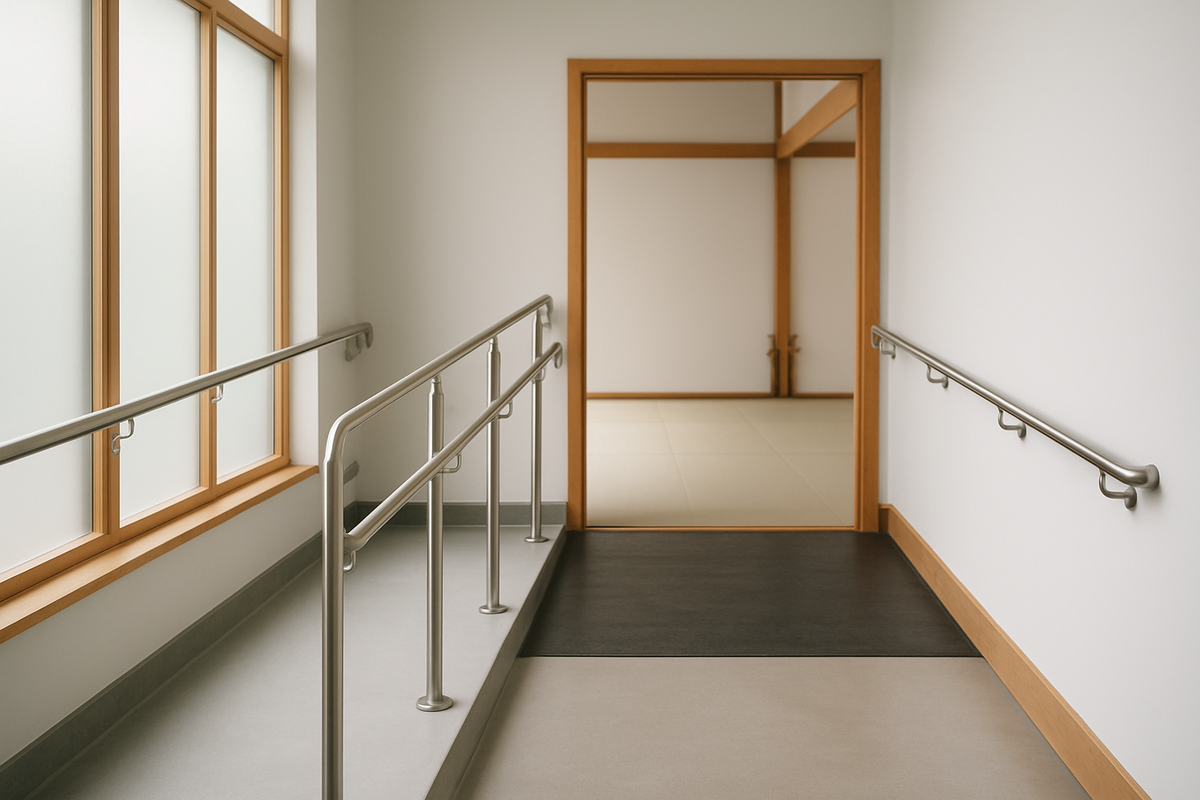
Several infrastructure elements require attention in martial arts schools. Entrance accessibility standards mandate that at least one entrance feature ramps or lifts where necessary, doorways wide enough for wheelchairs (minimum 32 inches clear width), and compliant thresholds. Automatic door openers, while not always mandatory, significantly improve access for students with mobility or upper-body strength limitations.
Training mats present a particular challenge. Standard gym mats range from 1.25 to 1.75 inches in thickness, creating vertical barriers and tripping hazards for wheelchair users and those with mobility aids. ADA guidance requires ramping solutions to mitigate these transitions. Mat ramps designed for fitness facilities typically cost between $200 and $800 depending on configuration and can be repositioned as training layouts change.
Equipment and training space must also provide accessible routes. The ADA specifies a clear space minimum of 30 inches wide by 48 inches long to allow wheelchair users to approach striking bags, weight training stations, or demonstration areas. When locker rooms and restrooms are provided, at least 5 percent (or a minimum of one) must meet full ADAAG provisions including grab bars, accessible stall dimensions, and compliant sink heights.
Cost of Non-Compliance and Typical Retrofit Expenses
As of 2025, the Department of Justice can impose civil penalties of up to $75,000 for a first ADA violation and $150,000 for subsequent violations. These figures do not include settlement costs, legal fees, or court-ordered retrofits that often accompany lawsuits. For context, California and several other states enforce stricter ADA compliance standards, increasing both litigation risk and liability exposure for access-related injuries.
Proactive compliance costs are substantially lower than penalties. Based on industry data, accessible parking installation including striping, signage, and clear access routes runs $3,000 to $5,000. Restroom renovations meeting ADA standards typically cost $5,000 to $15,000 per facility. Ramp installations range from $1,500 to $2,500, while doorway and entrance modifications add another $1,000 to $2,000. Many dojos can achieve substantial compliance for under $15,000 in total capital investment.
Case Law and the Limits of Exclusion
Can a martial arts instructor legally deny instruction based on disability? In nearly all cases, no. The landmark case Montalvo v. Radcliffe (1999) established a very narrow exception. The federal district court denied an ADA claim only after finding that a student's condition posed a significant risk to other students' health or safety and that no reasonable modification could reduce this risk without fundamentally altering the nature of the program. The bar for invoking this defense is extremely high and requires documented evidence of direct threat, not speculation or discomfort.
More recently, a 2024 case (Fernandez v. Asian World of Martial Arts, Inc.) brought ADA allegations against a martial arts supply company, demonstrating that compliance scrutiny extends beyond brick-and-mortar training spaces to retail operations and customer service practices. The case underscores ongoing vulnerability across all aspects of martial arts business operations.
Website and Digital Accessibility Cannot Be Ignored
Physical facility access is only part of the equation. ADA Title III website accessibility lawsuits filed in federal court jumped 27% in 2025, reaching the highest volume in three years. The Department of Justice and courts consistently apply WCAG 2.1 Level AA standards as the benchmark for Title III compliance by private businesses.
For martial arts schools, this means your website, class registration systems, and payment portals must be navigable by screen readers, provide text alternatives for images and videos, ensure sufficient color contrast, and allow keyboard-only navigation. Schools using third-party booking platforms should verify those vendors meet WCAG 2.1 AA standards, as you remain liable for inaccessible systems even when outsourced.
The Business Case: Adaptive Martial Arts as Revenue and Differentiation
Compliance is not purely defensive. The Disabled Martial Artists Alliance reports that nearly 240 million children worldwide live with disabilities that could benefit from adaptive martial arts programming. In the United States, the DMAA operates as the only facility of its kind offering specialized self-defense training tailored to unique accessibility needs, but the model is replicable.
Real-world examples demonstrate viability. My Martial Arts in Dallas, Texas launched an Adaptive Training Programme focused on adults and children with physical disabilities and developmental differences. The University of Kentucky's Human Development Institute developed instructor training modules on universal design, asking what accessible instruction looks like beyond physical space. These adaptive martial arts programs create new student pipelines, strengthen community ties, and position schools as inclusive leaders in competitive markets.
Instructor Training and Policy Modifications
Physical retrofits alone do not ensure compliance. The ADA requires schools to communicate as effectively with students with disabilities as with others and to make reasonable modifications to policies, practices, and procedures. Instructors must understand how to adapt teaching methods for disabled practitioners, from providing visual demonstrations for students with hearing impairments to modifying belt testing formats for those with speech disabilities.
Universal design principles ask what the built space of an inclusive dojo looks like and what accessible instruction entails. Traditional facilities typically do not address these needs, leaving students with disabilities more vulnerable and less confident in personal safety skills. Closing this gap through instructor education and policy review costs little but yields measurable improvements in program accessibility and student outcomes.
What This Means for Studio Operators
Editorial analysis, not reported fact:
Most dojo owners are not facing imminent lawsuits, but the combination of rising digital accessibility litigation, tightening state-level enforcement, and an aging student population makes proactive compliance both prudent and profitable. Start with a self-assessment: walk your facility with a wheelchair user or use a compliance checklist from the Access Board. Identify your highest-risk gaps, typically entrances, restrooms, and mat transitions, then price remediation with local contractors.
Simultaneously, audit your website against WCAG 2.1 AA standards using free tools like WAVE or engage an accessibility consultant for a formal review. If you are planning facility renovations or launching a new website, build compliance into the project scope from the outset rather than retrofitting later. Consider developing an adaptive program even if you start with a single weekly class. The skills your instructors gain teaching students with disabilities will improve instruction quality across your entire student base, and the market positioning advantage in 2026 is significant as more families prioritize inclusive environments.
Sources & Further Reading
- ADA.gov Title III Guidance, official overview of public accommodation requirements and compliance timelines
- U.S. Access Board Sports Facility Standards, detailed technical specifications for recreational and sports facilities including martial arts schools
- ADA Standards for Fitness Facilities, checklists and compliance guidance specific to gym and training environments
- ADA-Compliant Gym Mats, solutions and cost estimates for mat ramping and transition accessibility
- University of Kentucky HDI Inclusive Dojo Training, instructor modules on universal design and accessible teaching practices
- Disabled Martial Artists Alliance, primary advocacy and training organization for adaptive martial arts programming nationwide
- Montalvo v. Radcliffe Case Law, landmark decision defining the boundaries of disability-based exclusions in martial arts instruction
- 2025 ADA Penalty Amounts and Compliance Costs, current civil penalty figures and typical retrofit expense ranges
- 2025 Digital Accessibility Trends and WCAG Benchmarks, lawsuit volume data and website compliance standards for Title III businesses
Editorial coverage of publicly reported industry developments and regulatory requirements. Dojo Practice has no commercial relationship with any companies or organizations named in this article. This article does not constitute legal advice; consult with a qualified ADA attorney or Certified Access Specialist for facility-specific guidance.